Thursday, November 21, 2013

Mortgage rates fall amid weak economic data

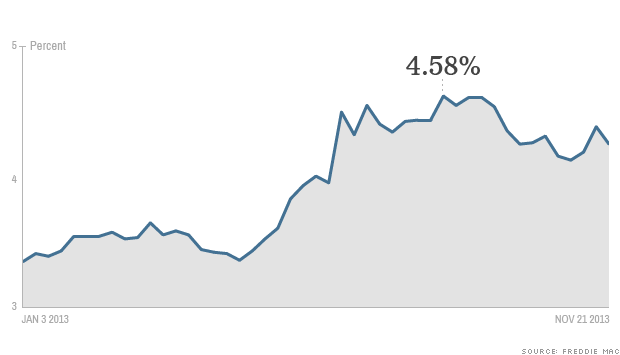
Average rates on 30-year fixed mortgages fell to 4.22% this week, down from a 2013 high of 4.58% in August.
NEW YORK (CNNMoney)

Mortgage rates fell significantly this week amid weaker-than-expected economic reports, according to a weekly survey by Freddie Mac.

30 year mortgage ratesThe average rate for a 30-year, fixed-rate loan, the most popular mortgage product, fell to 4.22% from 4.35% last week, Freddie Mac reported. Meanwhile, average rates on 15-year, fixed-rate loans, typically used for refinancing higher interest mortgages, dropped to 3.27% from 3.35% the week before.
This week's drop was one of the steepest during a year of mostly rising rates. The 30-year started 2013 at 3.34% and reached a high of 4.58% in August.
Related: American Dream homes: What you'll pay in 10 cities[1]
Frank Nothaft, Freddie's chief economist said fixed mortgage rates fell amid reports of weaker manufacturing growth, with industrial production declining by 0.1% in October, below expectations. He also cited declines in the overall inflation rate, noting that the consumer price index saw its "smallest increase since October 2009" last month.
Is there a housing bubble in California?  [2]
Is there a housing bubble in California?
Weighing on mortgage rates long-term is the Fed's stimulus program -- known as quantitative easing -- which entails that it buy $85 billion in bonds each month. The impending appointment of Janet Yellen as Fed chairman[3], who has defended the QE3 policy, has many believing the Fed's policy will remain in place.
Related: Five of the most (and least) affordable housing markets[4]
"Ms. Yellen would likely continue the QE policies started under Chairman Bernanke until there was very clear evidence that the economy would thrive, not just endure, without them," said Keith Gumbinger, a spokesman for HSH.com, a mortgage information company.

Find Homes for Sale…Check Out www.pearlandhomesforsale.biz.  Your Home Resource for Pearland and surrounding areas

Source : http://rss.cnn.com/~r/rss/money_realestate/~3/BsqpbQr8B0w/index.html 

How a Real Estate Agent Who Knows VA Loans Can Save Vet Thousands


Shutterstock

Selecting a real estate agent is one of the most important choices you'll make when buying or selling a home. The decision becomes even more important when you're a veteran or active duty service member looking to use the VA mortgage guaranty. This nearly 70-year-old loan program backed a record 630,000 home loans in fiscal year 2013, nearly double the 2011 volume.

That's a huge increase in just two years' time. You typically only need a credit score[1] of 620 to qualify for a VA loan, which is more than 100 points lower than some other mortgage products. (It's important to check your credit before applying for any home loan, including VA loans. You can pay for a credit score or use a tool like the Credit Report Card[2], which gives you free credit scores and a breakdown of what's impacting your credit.)

As lending standards have become more stringent, greater numbers of veterans are using their VA loan eligibility as the only realistic path to homeownership. The VA loan is a specialized loan program only available to those who have served our country, and, because of this, it comes with some unique requirements. Veterans can really benefit from an agent[3] who can educate and guide them through the entire process.

Closing Costs: If you've done much research on purchasing a home or have purchased a home before, you know there are closing costs associated with the loan. "Closing costs"[4] is an umbrella term for the fees and costs charged by the lender and third parties who conduct work on your file throughout the process, such as a title company. They research the chain of title for the property and complete a significant amount of paperwork to assist in your home purchase. Working with a VA-knowledgeable agent can even save you thousands of dollars when it comes time to go under contract.

The VA has established a list of certain fees[5] that you, as the buyer, are not permitted to pay. This is good for you, because it means your overall cost is lower. But your agent needs to understand these non-allowable costs so they can try to ensure the seller covers them when drafting an offer. Agents should also know how to structure an offer and eventually a contract to deal with closing costs. Because the VA loan is 100 percent financing, meaning you don't have to put any money down, you're not generally able to roll your closing costs into the purchase amount. But that doesn't necessarily mean you're stuck paying them, since your agent can ask that the seller pay all closing costs.

Your second option is to decide how much you want to offer on the home, get an estimate of your closing costs and then add the two together. By making an offer combining the two amounts, you are effectively rolling the costs into the loan. Sellers are generally more accepting of this method because it doesn't change their bottom line.

It's important to note here that the home will have to appraise for the full contract amount. If it doesn't, you'll have to renegotiate to lower the price or walk away from the deal. Agents unfamiliar with this strategy could mean thousands of dollars paid out of pocket to cover these costs or completely restructuring the contract, adding additional time to the process.

Property Requirements: The VA also has a set of minimum property requirements (MPRs) to ensure the property is safe and structurally sound for a veteran homebuyer and their family. A few examples of common MPRs include peeling lead-based paint, exposed wires or lack of a handrail on stairs. These repairs generally have to occur before you can close on the home, and, if the seller refuses or the repair can't be done, you will likely have to walk away from the home.

Failing to satisfy the property requirements can absolutely kill your deal. Veterans can also run into trouble trying to purchase unique properties, like geodesic domes, berm homes, A-frames and other relatively uncommon structures. The home appraisal process[6] revolves around good recent comparable home sales, and it can be tough to find workable "comps" for unusual homes or properties with significant acreage. Appraisals can cost around $500, which is a lot to spend on a home that's never going to fly with the VA appraisal process. That's why agents who understand these requirements can save veterans time, money and heartache.

VA-savvy agents can steer you from problematic properties at the outset, and also help guide you to closing if there's a shot at making the deal work. The experience of a VA-knowledgeable real estate agent is invaluable when shopping for a home. Be sure to ask any agent you interview whether they've closed VA loans before, and, if so, how many. By working with an agent experienced in VA loans, you'll be on the right track to a smooth home purchase.

Source : http://realestate.aol.com/blog/2013/11/21/real-estate-agents-va-loans/
Wednesday, November 20, 2013

Because No One Plans to Be Homeless

Hi, Book Scan readers. I spent the first part of last week hanging out with community planners at the American Planning Association's national conference. Though I haven't read the book described below, I thought the author (who gave the closing keynote at the conference) had some beautiful thoughts on home ownership that real estate professionals would appreciate. Enjoy! —MW

Early Pearl has a great idea for dealing with an intractable problem. As a homeless 11-year old Chicagoan, she sees all of the sturdy housing stock that stands empty and abandoned in her south side neighborhood and decides to take action.

From the cover of Blue Balliett's new book, Hold Fast

She gets some friends together and, with a few cameras, they snap pictures of these empty houses. They send the pictures—along with their imaginings of how the structures could be transformed into dream homes for kids without anywhere to live—to community leaders in an effort to spark a change in their unfortunate circumstances.

Early is only a character in Blue Balliett's newest mystery novel, Hold Fast[1] (Scholastic Press, 2013). But there are more than 30,000 kids in Chicago alone who are homeless just like she is, and some 16,000 vacant properties like the ones that Early dreams of inhabiting.

"Kids will easily share their dreams about a home," Balliett said in her keynote speech at the American Planning Association's national conference last week. "They never make small plans."

Balliett, a bestselling author of young adult literature, told planners that she came up with the idea for Hold Fast during the housing downturn, when she noticed a dearth of news stories about the effect foreclosures were having on her target audience.

"The children were invisible," she said. "I kept wondering about the kids: Who are they and what does it feel like to grow up without a front door?"

Of course, community planners, writers, and nonprofit directors know as well as real estate professionals the value of home when it comes to children.

"What kids need most is stability in their lives and a home provides that… Blue's book really captured that," said Chicago Coalition for the Homeless Executive Director Ed Shurna, who spoke on a panel alongside Balliett at the closing keynote of the APA conference. "The danger is that they are going to stay homeless as adults."

W. Paul Farmer, executive director and CEO of the APA, called on members to devote more of their attention to this difficult problem.

"As we have become arguably the best-housed nation in the world… we have allowed ourselves to not realize that we have these problems," Farmer said. "These are, in fact, invisible to many people in the country."

In a brief Q&A period, attendees asked panelists what they could do to help solve the issue in their local communities.

"Part of the key is to make your community care and take ownership in this problem," Balliett responded. "Become determined to do something."

Meg White[2]

Meg White is the multimedia web producer for REALTOR® Magazine and administrator of the magazine's Weekly Book Scan blog.


DePelchin's Children's Center Holiday Project in Need

The holidays are fast approaching! We invite you to make a dream come true for a child this year by participating in the annual DePelchin Children's Center Holiday Project.

This annual effort provides gifts and basic needs to the children and families utilizing DePelchin Children's Center services. During this time, local businesses, organizations and individuals sponsor children by fulfilling wish lists, hosting toy drives, donating needed items, making monetary contributions or volunteering to sort and pack gifts. With the support of the community, we are able to brighten the holidays for over a thousand children each season!

Here are four ways you can make a dream come true for DePelchin's children: 

For more information, please contact our Holiday Project coordinator at 713-802-7724 or email holidayproject@depelchin.org.